


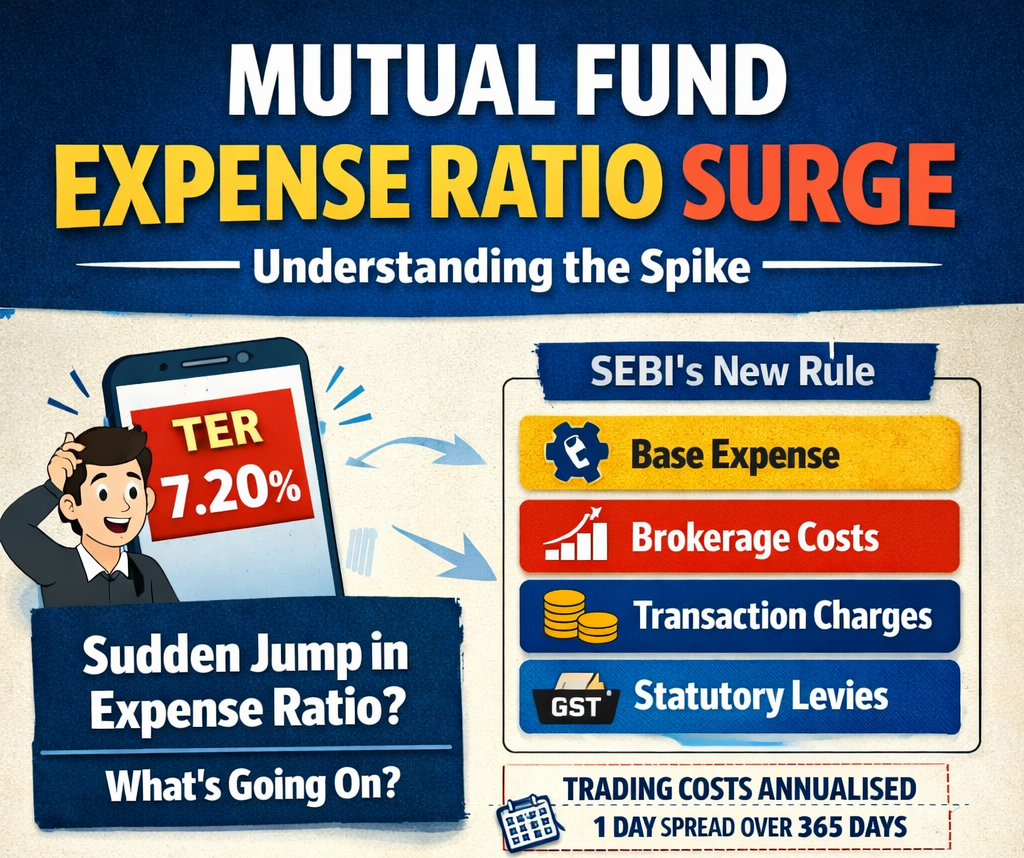

Motilal Oswal Midcap Fund’s expense ratio did not actually “jump” to 7.2% permanently — it was a one-day spike caused by SEBI’s new disclosure rules that annualise trading costs. The fund’s TER quickly normalised back to ~1.5%, so investors need not panic.
📌 What Happened
- On May 29, 2026, investors saw the TER at 7.2% in apps.
- SEBI caps TER at 1.5% for funds of this size, so the figure looked alarming.
- The AMC’s own site showed 6.44% on June 2, adding to confusion.
🏦 SEBI’s New TER Rules
From April 1, 2026, SEBI mandated a more transparent breakdown of TER into four heads:
- Base Expense Ratio – AMC’s fee + distributor commission.
- Brokerage Cost – Fees paid for stock trades.
- Transaction Cost – Execution charges for buy/sell orders.
- Statutory Levies – GST, STT, stamp duty, etc.
👉 The catch: brokerage, transaction, and levies only appear on trading days. If a fund trades heavily on one day, the TER looks inflated because costs are annualised across 365 days.
📊 Why the Spike?
- Example: A ₹100 NAV fund incurs ₹0.01 trading cost in a day.
- Annualised → 3.65% TER addition.
- Add base expense (~0.8%) → 4.45% TER reported for that day.
- Motilal Oswal Midcap Fund likely had large trades, causing the spike.
🔍 Not Just Motilal Oswal
- TRUSTMF Mid Cap Fund hit 7.28% TER on May 18, 2026.
- ITI, Quant, HSBC mid-cap funds crossed 4% TER on certain days.
- Large funds like Motilal Oswal get noticed first, but this is industry-wide.
✅ Normalisation
- Motilal Oswal Midcap Fund’s TER fell back to 1.54% the very next day.
- Spikes are temporary reflections of trading activity, not permanent increases.
- Investors should check TER trends over multiple days, not panic over one-day anomalies.
⚠️ Key Takeaways for Investors
- Don’t panic if TER looks unusually high — check if it normalises.
- Understand SEBI’s new rules: TER is now more transparent but can look volatile.
- Compare across funds: Mid-cap and flexi-cap funds all show similar spikes.
- Focus on long-term costs: Base expense ratio is the real recurring fee.


Leave a Reply