



💡 Introduction
When you invest in mutual funds, stocks, or any asset, the first question that comes to mind is — how much did I earn? That’s where Absolute Return comes in. It’s one of the simplest ways to measure how much your investment has grown or declined over a specific period, without comparing it to any benchmark or index.
📘 What Is Absolute Return?
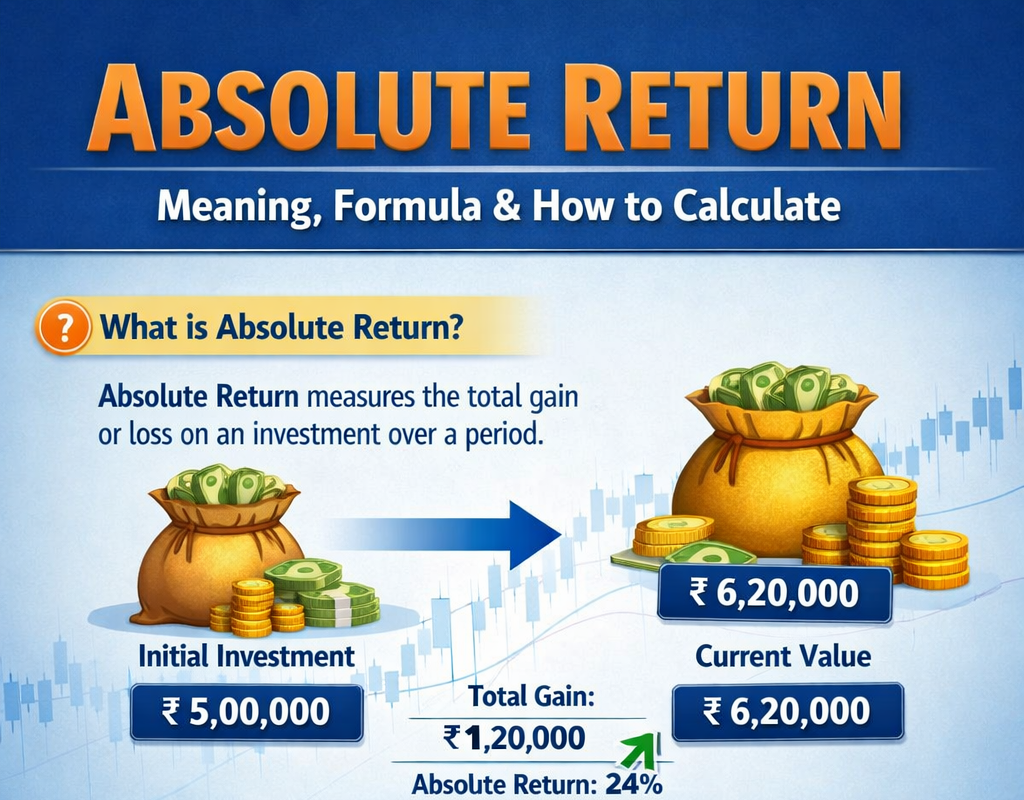
Absolute return represents the total percentage change in your investment value from the time you invested to the present. It focuses purely on your investment’s performance — not on how the market or other funds performed.
Example: If you invested ₹5,00,000 and the value increased to ₹6,20,000 after one year, your absolute return is 24%.
🧮 Formula for Absolute Return
Example Calculation:
So, your investment grew by 24% during the period.
📊 Why Absolute Return Matters
- Simple to Understand: It gives a clear picture of how much your money has grown.
- No Benchmark Needed: You don’t need to compare it with Nifty, Sensex, or any other index.
- Ideal for Short-Term Analysis: Perfect for evaluating SIPs, FDs, or mutual funds over a fixed duration.
- Helps Compare Investments: You can easily compare returns across different funds or asset classes.
⚖️ Absolute vs. Relative Return
| Aspect | Absolute Return | Relative Return |
|---|---|---|
| Definition | Measures total gain/loss | Compares performance to a benchmark |
| Benchmark Use | Not required | Required |
| Best For | Individual investment evaluation | Fund manager or market comparison |
| Example | 24% gain on ₹5L investment | 5% higher than Nifty 50 |
🧠 Key Insights
- Absolute return = total profit or loss on your investment.
- It’s independent of market benchmarks.
- Ideal for assessing personal investment performance.
- Helps investors understand real growth over time.
📈 Practical Use in Mutual Funds
Mutual fund investors often use absolute return to evaluate short-term performance — say, 6 months or 1 year. However, for longer durations, annualized returns or CAGR (Compound Annual Growth Rate) provide a more accurate picture of performance consistency.
🧩 Example Comparison
| Investment Type | Initial Value (₹) | Current Value (₹) | Absolute Return (%) |
|---|---|---|---|
| Equity Mutual Fund | 5,00,000 | 6,20,000 | 24% |
| Debt Fund | 5,00,000 | 5,50,000 | 10% |
| Gold ETF | 5,00,000 | 5,80,000 | 16% |
🏁 Conclusion
Absolute return is a straightforward metric that tells you how much your investment has grown — no benchmarks, no complex calculations. It’s perfect for quick performance checks and helps investors make informed decisions about where to invest next.
📚 FAQ Schema (for rich snippets)
Q1: What is Absolute Return in mutual funds? A1: It’s the total percentage gain or loss on your investment over a specific period, without comparing it to any benchmark.
Q2: How do you calculate Absolute Return? A2: Use the formula: (Current Value – Initial Investment) / Initial Investment × 100.
Q3: Is Absolute Return better than CAGR? A3: Absolute return is ideal for short-term evaluation, while CAGR is better for long-term performance analysis.




Leave a Reply