
📌 FD vs Liquid Funds: Which is Better for You?
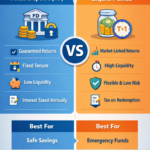
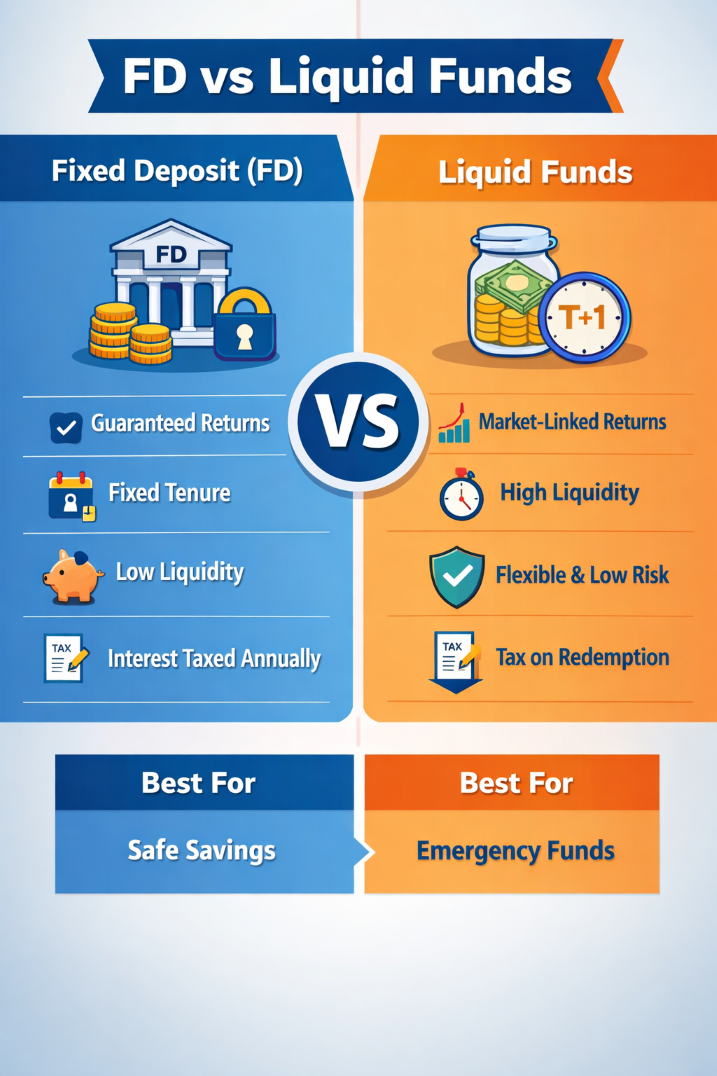
Fixed Deposits (FDs) and Liquid Funds are both popular options for short-term savings. FDs offer guaranteed returns with fixed tenure, while Liquid Funds provide flexibility and market-linked yields. The right choice depends on your need for certainty versus accessibility.
🔎 What is a Fixed Deposit (FD)?
- Definition: A lump-sum deposit with a bank for a fixed tenure.
- Returns: Guaranteed interest rate, unaffected by market changes.
- Tenure: 7 days to 10 years.
- Withdrawal: Premature withdrawal attracts penalties (0.5–1% lower interest).
- Safety: Bank FDs insured up to ₹5 lakh by DICGC. Company/NBFC FDs are not insured.
🔎 What is a Liquid Fund?
- Definition: A debt mutual fund investing in short-term instruments (maturity ≤ 91 days).
- Returns: Market-linked, not guaranteed.
- Tenure: No lock-in; redeem anytime.
- Liquidity: T+1 settlement, with instant redemption up to ₹50,000 or 90% of folio value.
- Safety: Diversified holdings, regulated by SEBI.
📊 FD vs Liquid Funds – Key Differences
| Feature | Fixed Deposit (FD) | Liquid Fund |
|---|---|---|
| Returns | Fixed & guaranteed | Market-linked, not guaranteed |
| Liquidity | Moderate (penalty on early withdrawal) | High (T+1 or instant redemption) |
| Risk | Very low (insured up to ₹5 lakh) | Low (credit & interest rate risk) |
| Taxation | Interest taxed annually at slab rate | Gains taxed at slab rate on redemption |
| Flexibility | Low | High |
| Best For | Risk-averse savers | Emergency funds & idle cash |
⚖️ Safety Comparison
- FDs: Safer due to deposit insurance (₹5 lakh cap).
- Liquid Funds: No insurance, but diversification and SEBI regulation reduce risk.
💰 Returns Comparison
- FDs: Predictable, fixed rate.
- Liquid Funds: Yields fluctuate with interest rate cycles. Better in rising-rate environments.
🏦 Taxation
- FDs: Interest taxed annually, TDS applicable.
- Liquid Funds: Gains taxed at slab rate only on redemption (defers tax liability).
🚨 Risks to Consider
- FDs: Inflation risk, reinvestment risk, premature withdrawal penalty.
- Liquid Funds: Credit risk, NAV fluctuations, market-linked returns.
✅ When to Choose FD
- You want guaranteed returns.
- You have a fixed investment horizon.
- You prefer safety over flexibility.
✅ When to Choose Liquid Fund
- You need quick access to money.
- You’re building an emergency fund.
- You want better yields than a savings account.
🏁 Final Thoughts
FDs prioritize certainty, while Liquid Funds prioritize flexibility. Many smart investors use both — FDs for locked-away savings and Liquid Funds for emergency or idle cash.